
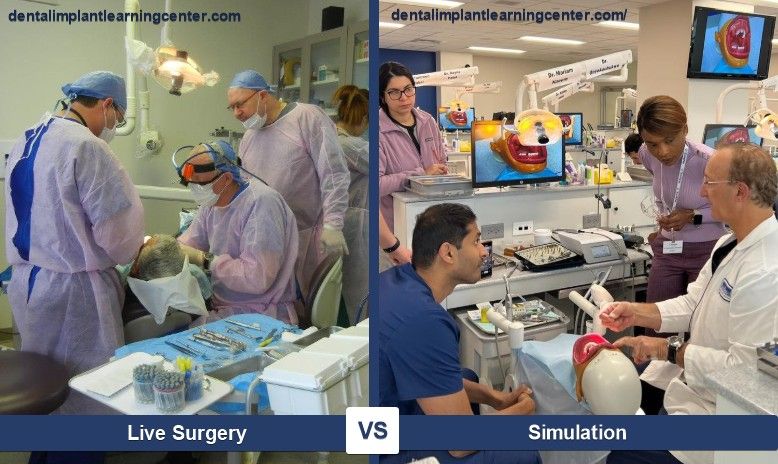
Advanced surgical education in dental implantology encompasses two core training methods: live surgery and simulation-based practice. Each offers unique advantages and learning opportunities, and understanding the difference between them is key to advancing your surgical skills and confidence as an implant practitioner.
This article will define each method and outline its respective benefits to help you determine the best approach for your dental implant training needs. Choosing the right educational path is the first step toward clinical excellence and mastery in implant procedures.
Live Surgery Training
Live surgery training involves performing actual implant surgery procedures on live patients under the direct, one-on-one supervision of experienced instructors. These training programs are often referred to as supervised surgery programs, emphasizing the critical safety net provided by the expert mentor. These programs typically take place in a genuine clinical setting, often within a dedicated training center, a university surgical clinic, or sometimes even in an international clinical environment designed for high-volume learning. The atmosphere is professional, regulated, and mirrors a high-level private practice or hospital setting, preparing the surgical trainees for the real world.
Participants are guided through every step of the implant placement or bone grafting procedure. This comprehensive surgical training extends from the initial and detailed patient assessment, through meticulous treatment planning, to the surgical execution itself and essential immediate post-operative care. This holistic experience ensures the surgeon does not just learn a technical step, but masters the entire professional workflow required for full patient management. [1]
Benefits of Live Surgery Training
Live surgery training offers unmatched benefits that are essential to achieving advanced surgical competence and lasting implant practitioner skills. This method is important for the transfer of skills from the laboratory to the clinical setting.
Real-World Experience
The most significant benefit is the direct, hands-on experience with a live patient. This immediate exposure thoroughly prepares trainees for the unexpected challenges that are always a part of clinical practice. It moves the learning far beyond theoretical knowledge. This direct exposure transforms your abstract understanding into applied, practical surgical skill.
Managing Unpredictability
No two patients are exactly alike. Live surgery teaches you adaptability. You learn how to react immediately to real-time variables like unexpected bleeding or a sudden drop in blood pressure. Managing unforeseen complications during a procedure builds critical problem-solving skills under pressure.
Comprehensive Patient Management
Live training involves the entire patient journey, extending beyond the procedure itself. You practice essential soft skills, including patient communication, obtaining proper informed consent, and managing pre-operative anxiety. This prepares you for the full cycle of care, from initial consultation through post-operative instructions and follow-up. This complete dental implant education prepares the practitioner for every aspect of the case.
Building Confidence
Successful procedures on live patients, even while under close supervision, significantly boost a trainee’s confidence and self-efficacy. This positive psychological impact is one of the most invaluable outcomes of live training. Feeling truly capable and prepared helps you smoothly and immediately integrate these new, advanced skills into your own independent practice, allowing you to market and offer new services with assurance. The confidence gained in the operating room translates directly to success in the consultation room. [2]
Mentorship and Immediate Feedback
Trainees receive instant, personalized feedback from expert instructors, often senior surgeons with decades of experience. Mentors can literally guide the trainee’s hand, correct technical errors on the spot, and offer tailored advice rooted in years of clinical experience. This immediate correction loop is invaluable for refining surgical technique. It ensures that best practices, safe habits, and the highest standards of care are adopted instantly, preventing the formation of bad habits. [3] This immediate feedback is a core advantage of supervised surgery.
Simulation Training
Simulation training refers to any educational method that replicates a clinical procedure without involving a live human patient. This category is expansive and encompasses a wide array of modalities, ranging from low-fidelity plastic simulation models to high-fidelity cadaver labs and sophisticated haptic virtual reality systems. Simulation is the vital first step in progressive surgical education and is increasingly viewed as a crucial training tool. [4,5]
Cadaver training allows trainees to practice on human anatomical specimens. This provides a realistic experience, specifically with the handling of soft tissue and bone. Working with cadavers allows a surgeon to experience flap design, vital structure location, and bone graft handling in a near-perfect replication of clinical anatomy, making it a highly valid simulation.
Other surgical simulation techniques use 3D-printed models of patient-specific anatomies or highly detailed manikins. These models are engineered to provide realistic tactile feedback for physical skills like precision implant placement, guided bone manipulation, and advanced flap design in a controlled trial environment. These techniques isolate the physical skills necessary for surgery, allowing the trainee to focus on muscle memory and procedural adherence. May include the use of virtual reality temporal bone and other VR training systems which represent a future for surgical skills acquisition.
Benefits of Simulation Training
The fundamental advantage of simulation is the elimination of patient risk, allowing you to practice complex or challenging procedures repeatedly without clinical consequences. Recent controlled trial studies support the effectiveness of simulation tools in rapidly improving technical skills.
Risk-Free Repetition and Error Correction
Simulation provides an ideal environment for initial skill acquisition and mastery. You can focus purely on learning the steps of a protocol, proper instrument handling, and strict aseptic technique. Simulation allows you to “fail safely,” meaning you can make and correct mistakes that would be critical or dangerous in a live patient setting.
Targeted Skill Acquisition
Using specialized simulation models, trainees can choose a course that focuses intensely on a single, specific skill, such as advanced ridge splitting, specific bone grafting techniques, or a challenging sinus augmentation procedure. This allows for highly targeted learning without the unpredictable factors of a live patient. Simulation allows the surgeon to focus solely on mastering one complex technique. This isolated approach enables you to drill down and perfect that skill thoroughly before introducing patients, a key element of effective skill training.
Accessibility and Time-Efficiency
Since simulation courses often take place over shorter, fixed periods, they are typically more accessible and time-efficient if you have a busy schedule. This ease of access and focused time commitment helps you maintain your practice while upgrading your skills quickly.
Low-Stress Procedural Mastery
The simulated environment is inherently low-stress, enabling you to proceed at your own comfortable pace. This focus allows you to ensure complete procedural mastery of all necessary steps and instrument movements. Building this foundational competence reduces anxiety before moving into a high-stakes clinical setting.
How To Choose Your Ideal Training Path?
Choosing between simulation and live surgery isn’t about finding the better course. It is about matching these training options to your current skill level, practice goals, and personal risk tolerance.
The most effective and safe pathway for any aspiring implant practitioner integrates both methods sequentially. The optimal strategy is to view simulation and live surgery as sequential, critical components designed to upskill you toward implant mastery.
Here is a detailed guide to help you determine which training focus is right for you now, based on your current experience:
Beginner
If you have no surgical implant experience, you should start by focusing on Simulation training to master basic biomechanics and surgical steps, primarily Cadaver courses, and manikin models to build foundational muscle memory and ensure procedural accuracy before ever touching a live patient. Initial training must be comprehensive and risk-free.
Intermediate
If you have completed a didactic course and practiced on models, you are now ready for Supervised Live Surgery. This is recommended to gain clinical confidence, manage simple cases, and better understand soft tissue response, typically through live patient treatment sessions.
Intermediate-to-Advanced Practitioners
If you have already been placing implants but seeking new skills, the best fit is a combination of High-Fidelity Simulation & Live Surgery. This involves using detailed cadaver dissection to master complex anatomy, which is essential for advanced procedures like sinus lifts. This anatomical preparation is then immediately followed by supervised live patient surgery for safe skill acquisition.
Advanced
If you have been routinely placing implants and are seeking mastery in complex procedures (e.g., mastering full-arch reconstruction or complex bone manipulation), you should pursue Advanced Live Surgery within the structured Live Hands-On Implant Surgical Programs. These programs focus on high-level training, such as full-arch reconstruction or complex bone manipulation. You will work on challenging patient cases guided by senior specialists, significantly expanding your expertise. This is often the final phase of residency training or higher surgical training.
The most effective implant training follows a structured curriculum that combines simulation and live surgery as essential, sequential steps.
At leading implant surgical education centers like the Dental Implant Learning Center (DILC), this integrated and progressive approach is the foundation of success for every aspiring implant practitioner. Structured programs like the AAID MaxiCourse or year-long Live Hands On Implant Surgical Program embody this continuum perfectly.
Through a progressive and intentional blend of comprehensive lectures, focused simulation practice, and essential supervised live surgery, you advance at a steady, safe pace. You are always challenged to grow, but the structure ensures you are never unprepared for the next step. This approach ensures your clinical confidence, procedural precision, and ultimate readiness for safe, independent implant practice.
Final Thoughts
Both live surgery and simulation training are essential pillars in mastering dental implant procedures. They should be viewed not as competitive alternatives, but as critical, sequential components of a complete curriculum.
Simulation gives you the freedom to practice safely, refine your technique, and build precision without the pressure of working on a live patient. Live surgery, in turn, transforms that preparation into real-world confidence as you treat actual patients, make clinical decisions on the spot, and learn directly from expert mentors.
If you’re just starting your implant journey, begin with simulation to develop your skills in a risk-free, supportive setting. Once you feel confident in every procedural step, you are ready to take the next safe and impactful leap into supervised live surgery.
At the Dental Implant Learning Center, we ensure you gain the ultimate confidence and real-world proficiency needed for your practice. Review our upcoming course dates and register for our program that matches your exact skill level.
Start your advanced implant training now!
References:
- https://www.dentalimplantscourse.com/the-educational-impact-of-live-surgery-in-implant-dentistry/
- https://www.expdentalsolutions.com/hands-on-dental-implant-training-live-surgery-course-for-usa-dentists/
- https://dentagama.com/clinicpages/9678/why-training-with-live-patients-makes-a-difference-in-your-dental-implant-education
- https://pmc.ncbi.nlm.nih.gov/articles/PMC11558898/
- https://pubmed.ncbi.nlm.nih.gov/33358139/